כִּשּׁוּרֵי חַיִּים
קבלת השונה
מפגש עם מי ששונה מאתנו יכול להיות מאתגר ולהעלות חשש, אך טמונה בו אפשרות ללמידה, והזדמנות להתפתחות ולפיתוח סקרנות ורגישות. דרך ספרים וסיפורים על קבלת השונה אפשר לגעת בהתמודדויות אמיתיות מחיי הילדים ולטפח מיומנויות חברתיות חשובות.
סְּפָרִים

Book-Related Family Activities
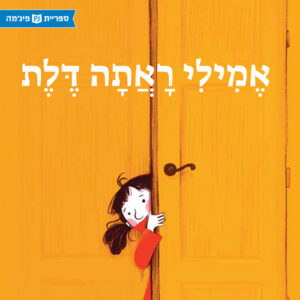
Opening a Door
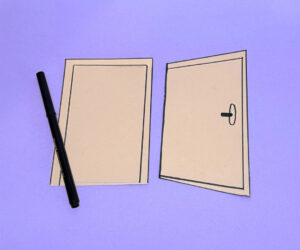
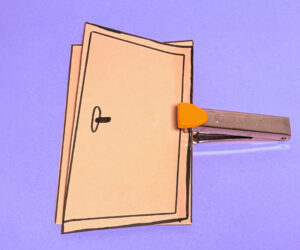
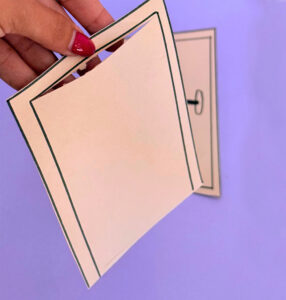
The doors in the book are real, but they are also symbolic. You can look together at the doors that Emily encounters and ask: “What doors appear in the story?” “How does each door react to what Emily says?” “How did Emily feel when a door did not suit her?” “What would you do if you were in her place?” “How can you know which door suits you?”
Knock Knock! What’s Behind the Door?
Ready to play an enjoyable family game? Take turns with every family member inventing a special door and a way to enter it. For example: “Knock knock! What door is this?” – “The frogs door!” “And how do you enter this door?” – “Jumping on all fours and making croaking noises!”
My Door
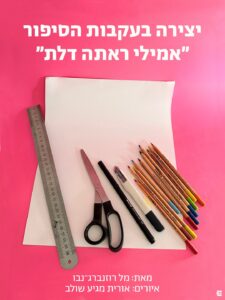
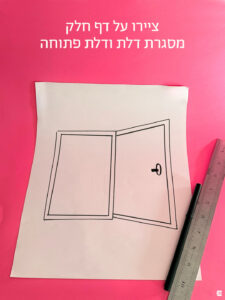
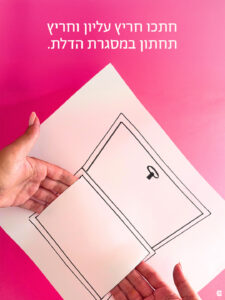
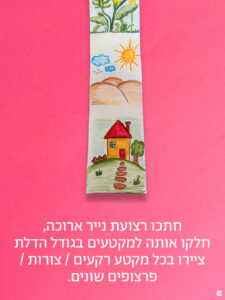
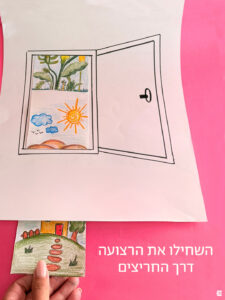
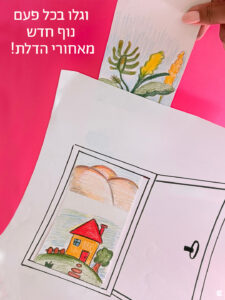
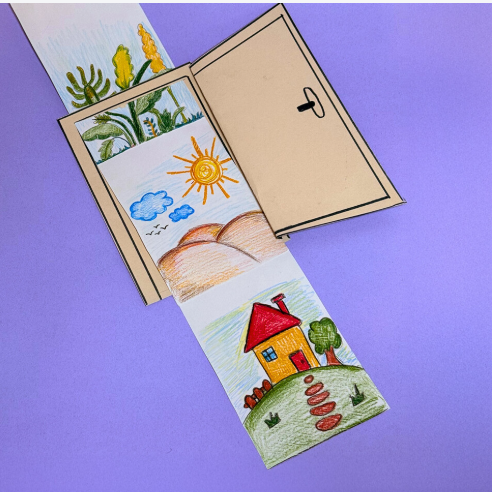
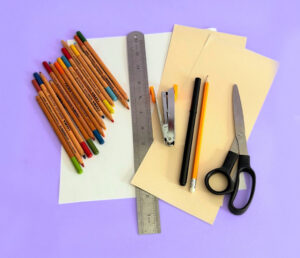
You can invent your own special door, and then draw it along with all the things you would want to be behind it. You can try to imagine what will happen when Emily knocks on this door.
Prepare a Door Sign
You can prepare a special sign for the front door or any room in the house. Think about things you like and make you happy. You can draw them around the words on the sign, or look for them in magazine pictures and cut and paste them on the sign.
Tips for family reading
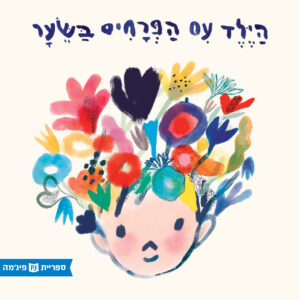
This is a special book that delicately addresses coping with a friend’s complex physical or emotional state. We recommend that parents read this book before reading it together with their child in order to adjust the reading and discussion to the book’s unique content, and the child’s unique world.
“And I found a way”
David’s friend immediately notices when David’s behavior changes. You can discuss and share: Have you ever noticed when someone you have been close began to act differently? What did you do? What do you think about what Davd’s friend did?
Paper flowers – a kind gesture and a good word
Invite your child to make a colorful floral crown that would bring joy to your family. Suggest that your child cut out paper flowers and decorate them, and then write a kind word about each .family member
A “just in case” box
What comforts and cheers you up during difficult times? A kind word? A touching book? Perhaps a toy? You can make a box filled with “just in case” ideas: Items that cheer you up, encouraging messages, and kind words.
A hug in a letter
Does your child have a friend or family member who is coping with a complex physical or emotional condition? You can suggest that your child write that friend or relative a letter of encouragement. Use supportive words, such as: I’m here for you; you’re strong; we’re your friends; and we love you. You can add a drawing that will put a smile on their face too.
Family reading advice
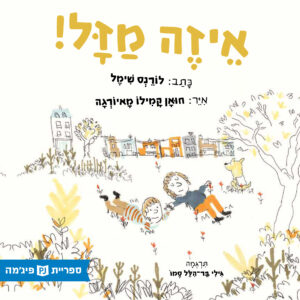
This is a special book about a special family, in which one brother is visually impaired or blind. The narrating brother is well aware of the challenges in his family and the restrictions required of him at home, yet chooses to see the world in a positive light. We suggest that you, parents, read the book before reading it together to adapt the reading and discussion to this book’s unique contents.
Discussion
Do you think the child in this story is lucky? Why? What makes you lucky? You can share with one another, parents and children, the good things in your shared life as a family. You can create a regular ritual during which, once a week, family members share the positive things that they experienced that past week.
What can you see…?
How do blind children experience life? Scan the code to watch an episode of “I’m sorry for asking” about blind children. Following the video, you can discuss what makes our lives similar to or different from that of the children depicted in the video.
What do we discover when we reread?
Rereading can reveal new and surprising things. We recommend reading the book twice, looking at the illustrations and searching for clues about Hagay’s visual disability: What about the words and illustrations hints at this family’s challenge? Did you notice it the first time you read the book?
Make believe
Hagay knows how to tell made-up stories. You can try it too! How about choosing two items and using them to tell a made-up story: a brush and a rug, a bottle and a stuffed cat, a hat and a window – what can happen to them in the made-up story you will come up with together?
More arts & crafts and activities can be found on the Sifriyat Pijama Pinterest page.
Family reading advice
Books can help to prepare for a special occasion or collect memories from a recent event. For example, before a holiday, you can choose a book that speaks about it and discuss: Which events did you plan for the holiday? How can both parents and children prepare for it? In preparation for Purim, you can make a costume or mishloach manot together, and after the holiday, you can read the book again to help you remember the beautiful moments you have just experienced together.
The costume game
Walk around the house and pick an item: a spoon, a plant, a ball or… a rug. Take turns describing a costume that includes the chosen item: Is the rug part of a rug seller’s costume? Or is it a flying carpet? Is the ball part of an athlete costume? Or a clown’s nose?
תחפושות ופורים
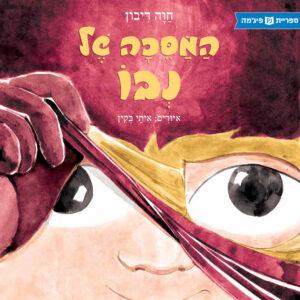
This book provides an opportunity to share Purim memories: Do you like dressing up, and if so, do you only do so on Purim? Did you, parents, enjoy dressing up while you were growing up? Which costume brings back good memories? You can find out who likes to dress up and who prefers not to, look at photos from the past and be reminded of special Purim moments.
What it means to be different
We are all different in some way. Scan the QR code to meet Uffnik and friends for a discussion on the word “different”.
Illustrated costumes
Where in the book can you find an astronaut’s costume? And what about a Queen Esther, firefighters, police officers or Albert Einstein? You can look for the costumes in the illustrations. Which one is your favorite?
Who was Albert Einstein?
Albert Einstein [1879-1955] was a Jewish German scientist. The relativity theory he developed and other studies he conducted made a big impact on the world of science and on how the laws of nature, time and the universe are perceived. Einstein had a sense of humor and imagination, promoted peace and fraternity, and loved corresponding with children from all over the world. Einstein supported the establishment of the Hebrew University in Jerusalem, and the State of Israel in general.
A tip for family reading
You can find something to like in every book: The drama, the characters, or maybe the illustrations or interesting words. After reading the book, try asking the children what they liked about the story, and share what you, the parents, enjoyed. You can even tell each other which books you especially like and why.
Friends and us
Peetz and Morchella are spending time together. She’s growing vegetables and he’s nurturing them. In the meantime, they are chatting, singing, and simply enjoying their time together. You can ask the children what they like doing with friends. What do they do together? As parents, this is a good opportunity to reminisce with your children and share your experiences and memories with childhood friends.
Vegetables and drawings
Cabbage? Kohlrabi? – Thirteen types of edible vegetables appear in the book. Can you find them all? You may want to eat your favorite vegetables or try new vegetables.
Nice to meet you: the morchella
So, who are you, Morchella? If you scan the code, you’ll learn about the morchellas that sprout up in Israel each winter. Do you want to learn more? Go to the library together or surf the internet and look for information on morchellas and other mushrooms.
Growing vegetables
You can grow vegetables, even if you don’t have a plot of land. Try taking a cut carrot top, cloves of garlic, or the bottoms of lettuce or celery, and soak them in a transparent container with water. Wait patiently, add more water if needed, and little by little, you will see leaves and roots sprout. You can cut them off and eat them, or plant them in a flowerpot, and wait for new vegetables to grow. Don’t forget to water them!
Words of emotion
The letters in the story describe feelings: missing someone, loving someone, feeling happy…
How about making some cards with words of emotion, as well as phrases that describe these emotions, and connecting each word with the sentence describing it?
Missing someone: I wish we could see each other again
Loving someone: It feels good when we’re together
Feeling happy: This tune makes me want to jump up and dance
Feeling thankful: I’m so glad we met! Thank you for coming round!
Having a party
Would you like to party like Rosalinda and Aaron? You could use the invitation they made to write an invitation of your own, prepare one of the dishes they had at their party, play some party music, and dance together.
You could even take some photos during your party, and save them in an envelope inside the book you’ve received.
Reading the illustrations
Randomly open the book and look at the illustrations together:
Which character is similar to you? Which character are you different than?
What makes you similar to or different than the character you have chosen?
Which is your favorite character in the book?
Note – these questions may be asked every time the book is read. There are days, for example, when we prefer to be alone, whereas on others we choose to spend time together.
Playing – What can we see in the mirror?
The mirror game presents an opportunity to look at one another as well as ourselves, notice similarities and differences, and laugh.
Instructions:
Sit in front of the mirror with your child, look at each other, and find similarities and differences between you:
Are your eyebrows arched the same way as your child’s?
Do you both have freckles? Or curly hair?
Pulling Faces – one of you could pull a funny face, while the other tries to mimic it. Were you able to make each other laugh? Was it the same funny face that made you both laugh, or different ones?
Doing some arts & crafts – Similar but different
You could make a family picture together, and add your similarities and differences to it:
Take photographs of yourselves together or separately. If you prefer, you could draw self-portraits instead of taking pictures. Print the photos out, paste them on some cardboard, and paint them. Add drawings or newspaper scraps to your pictures with details representing the similarities and differences between you. Do you enjoy playing the same games? How about adding it, then? You could add the different games that each of you like to play. Perhaps one of you prefers quiet, while the other prefers noise. Are you fast or slow? Do you find the same jokes funny? What else would you add to your family photo?
Moving similarly – Moving differently
Would you like to be active? Here are some suggestions for physical exercises that consist of both similar and different movements.
In each round, one of your family members moves their body: eaves their hand, jumps, turns around, or touches their ears.
The person next to them then moves too: if they like the gesture made by the previous participant, they can move in a similar way. If not, they can choose a different movement they like better.
What did you enjoy? Repeating the same movement, or choosing your own?
Scan this code to download a family game we have prepared especially for you.
Proposed Family Activities:
- You may want to act out the story using puppets, and invite each character to explain how they ended up being friends.
- There are two illustrations of the house in the final pages of the book. You may want to ask your child if they can spot the difference between them. What’s been added to the second illustration?
- Is there a teacup, piece of furniture, or photograph that’s been in your family for a long time? Perhaps there is an interesting story associated with this item. If so, you may enjoy sharing it with your child.
- Your child may like to draw your home and loved ones. Together, you can make a frame for their drawing, and hang it up on the wall.
- Have new neighbors come to your neighborhood recently? Perhaps you know new Olim who have arrived in Israel not too long ago? You may want to make a greeting card for them in the spirit of this book, and print the word “welcome!” on it.
- Where does your family originate from? Perhaps you could open an atlas, and show your child the journey made by your family on their way to Israel. You may want to tell your child about your own childhood home, and show them photographs of homes in which you have lived over the years.
Proposed Family Activities:
- You may want to snuggle up and look through the book together. Ask your child some of the following questions: did any of the illustrations make you smile or sad? Are you familiar with all the animals in the book? Do you think they all make suitable pets? Try to imagine being able to have an unusual pet: which one would you choose?
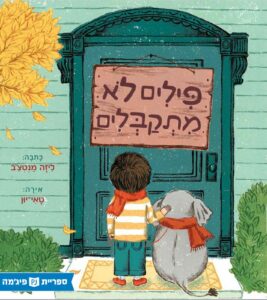
- We suggest taking a moment at the page on which the boy and his tiny elephant reach the pet club, and reading the sign out loud. You could discuss what, in your opinion, is the reason why elephants are not allowed into the club. How does that make the boy and his tiny elephant feel? Before you go on reading, you could perhaps hazard a guess as to what the boy would do next.
- How about making a model pet club from a shoebox, and acting the story out together using some puppets. You could enhance the story by making up conversations between characters.
- “Because that’s what friends do” – you may want to share a special friendship you had during your childhood with your child. What did you enjoy doing together? Which games did you play? Who are your child’s friends, and how do they like to spend their time together? Is there a boy or girl from kindergarten who has never been round to your house? Perhaps you could have a gathering of friends of all ages – because all are welcome to the family club!
- You may enjoy making a sign for your child’s bedroom together, and writing a welcoming greeting on it, such as “all are welcome here”, or “welcome, one and all”.
Enjoy reading and discussing the book together!
Proposed Family Activities
- You may want to sit close together, read the story, and enjoy the illustrations. Which amusing details and play-on-words did you discover in the illustrations? Perhaps you could ask your child to tell you the story according to the sequence of illustrations.
- At the end of the book, the animals try on each other’s tails, wings and fins. What is each new animal comprised of? You may enjoy coming up with names for them.
- Somebody is jealous of the other animals, and wants to be like them. Have you ever wished you were more similar to someone else? You may want to share those experiences with your child. Perhaps you could discuss the differences and similarities between your family members, what makes each of you unique, or unites you all. This may be a good opportunity to strengthen your child’s inner qualities, and encourage them to remain true to themselves.
- Perhaps you would enjoy acting the story out together. Using various fabrics and accessories, you could make wings, tails, whiskers and feathers. You may want to keep all the disguises and props in an easily accessible basket, and encourage your child to dress up as a different animal each time, bringing the various characters in the book to life.
- Do not judge a book by its cover: we are accustomed to describing people using their external features. Can you describe one another without referring to any external features? Was it hard?
- This book may inspire you to set up a “garage sale” with clothes, costumes, and accessories that are lying around your house. Invite family and friends over, and together you can play dress up, exchange items, and feel brand new.
- You may want to look for other books on dressing up at home, in kindergarten, or at the local library, and read them together. Books such as BrownStripe (Humpas) by Shlomit Cohen-Assif, An Egg in Disguise (HaBeitza Shehithapsa) by Dan Pagis, or A Very Honorable Coat (Tochal, Meil, Tochal) by Ronit Chacham.
What makes one a hero?
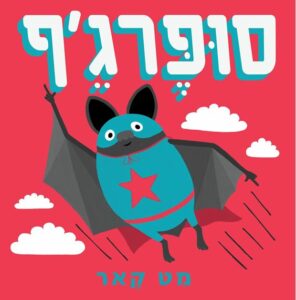
What makes one a hero? You may want to stop reading when Pat realizes he has no special powers. You could discuss Pat’s feelings with your child – what would they have told him right now? What could have comforted him? You may also wish to ask: Is not being a superhero that terrible? What sort of qualities might make one a hero? And who are your heroes?
Uniting and distinguishing:
Uniting and distinguishing: Which qualities do members of your family share, and which make each of you special? What distinguishes your family from others? You could discuss this with your child, and ask them to draw two pictures: a family portrait highlighting common traits, and another emphasizing each family member’s uniqueness.
Make believe:
Make believe: Many children enjoy playing with superhero action figures, and pretending that they too have special powers. You may want to join in on their game, taking an interest in the superpowers possessed by your child’s favorite characters, and letting your imagination run wild. If you also spent time playing superheroes as children, or reading comic books, you could tell your child about your childhood toys, books, and movies, and compare them with today’s superheroes.
Walking in the dark
Walking in the dark: Pat can find his way in the dark. Can you? You may want to turn off all the lights, and walk from one room to the other holding hands. Feel your way around, and rely on your knowledge of your surroundings. After several times, you could allow your child to lead you.
Interesting animals
Interesting animals: You may enjoy reading the fun facts about bats printed on the last page of the book together. Did your child know bats shared these characteristics? You may want to visit a petting zoo, zoo or pet store, look for information online or at the library, and prepare a similar page about a different animal.
Family Activities
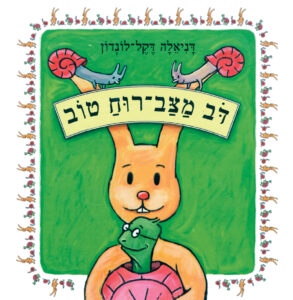
- Perhaps you would like to look at Daniella Dekel London’s amusing illustrations, and use them to follow the plot. What do the animals like doing together? Did you find the three ants running away? Have you managed to identify the various animals concealed in Good Mood Bear?
- You may enjoy acting this story out together. Who can be the bear, and how will you disguise yourselves? And who will play the part of the other animals? At the end of the show, you could make some sandwiches and eat them together in a special friendly picnic.
- Many things can put you in a good mood: playing with friends, singing and dancing, or hugging. Perhaps you would like to discuss the various things that make you happy, and choose one that fills your heart with delight – like singing and dancing together, going for a walk in the neighborhood, or reading your favorite books together!
- The bear in the book makes new friends, and the group has a great time together. Following this story, you may want to invite a new friend home, and try out new things together. Have you made a new friend? Did spending time together put you in a good mood?
- “I’m bored and have no one to play with!” Just like the bear, we have all felt sad or bored at times, and do not always have friends around. You may enjoy preparing a “good mood kit” together: decorate a shoebox, and put little prizes in it, such as stickers, crayons, or small games. Keep the box hidden, and take it out when you’re lonely or bored.
- Perhaps you could make little bears from various items. What could you use for round ears? And how will you give it a chubby belly?
- You and your child can also dress up as bears, other animals, and even various family members. You may want to create a costume and prop basket, filled with various materials, hats, glasses, and household items. Dress up, guess each other’s costumes, and get in a good mood!
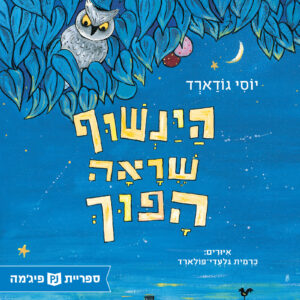
Introducing Palindromes
A palindrome is a word, sentence, or number that can be read the same way from left to right or right to left. There are many palindromes in this book that are written in light blue. You can read them together from both ends, and perhaps find other palindromes that do not appear in this book.
A Reversed Family
You can discuss the differences between members of your own family. In what way are we “reversed” or different from one another? How do these differences make us feel? Do they contribute to your family? Or make things harder? What do we stand to gain when someone’s view of things is the exact opposite of ours?
QR Code
Scan the code to listen to more Sifriyat Pijama books being read on the “Yarden and Didi in Pajamas” podcast
A Reversed Day
You can do the opposite of what you normally do – draw with the hand you use least, walk a different way than you usually do, or change the order of things you do in the afternoon to see what you can learn from this experience.
Reading for Fun
You can invite your children to participate in reading in various ways: Take turns reading – one line each; select a recurring keyword in the book, and look for it on every page; or let them choose their favorite page or sentence to read aloud.
מבשלים פנקייקים עם רות סירקיס!
צפו במתכון המיוחד לפסח של רות סירקיס לפנקייקים! מתאים לכל ימי השנה!
Family Activities
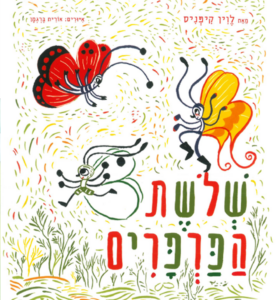
The story of the three butterflies was first published in 1938, and has since accompanied many generations of Israeli children. Do you know of an earlier version of the book containing other illustrations? You may want to take a look together at Orit Bergman’s illustrations. Have you noticed that the butterflies’ wings are multicolored? You may like to consider why the illustrator chose to paint the butterflies this way.
The three butterflies look out for one another and refuse to be separated. You may want to discuss friendship and mutual obligation together, be it between friends or family members. Perhaps you’d like to share stories about your friends and your child’s, and the things you enjoy doing together. Following the story, you might want to ask your child if they or their friend had ever been prevented from joining in a game, how that made them feel and what they did in response.
The flowers are only willing to allow those who are of a similar color in. You may want to compare the illustrations of the flowers to those of the butterflies. What similarities and differences can you find between them? You may like to ask your child what they think of the flowers’ behavior.
You may also want to act the story out as a family by dressing up in the colors of the flowers and butterflies. You could also create a puppet theater, with characters for the butterflies and flowers, using popsicle sticks and cellophane.
You might enjoy going outside and looking for butterflies and flowers! Just like in the story, flowers and butterflies in nature differ from one another, each having their own particular color and shape. Have you come across a tulip or lily? How many types of butterflies have you found, and what color were they? Do you happen to know the name of any butterfly? Perhaps you’d like to mimic the way butterflies move, and invent the Butterfly Dance together.
Levin Kipnis wrote hundreds of well-loved children’s poems and stories that form an integral part of Israeli culture. You may wish to look for them at home, in kindergarten, or at the library, and read them together.
Levin Kipnis
Levin Kipnis was one of Hebrew children’s literature’s founding fathers. He wrote and translated many literary pieces for children, and also set up and managed the first children’s theater in Israel. In addition, Kipnis edited numerous journals, anthologies and text books.
He was born in the Ukraine in 1894 and immigrated to what would later become the State of Israel in 1913. He felt there were not enough holiday songs and stories in Hebrew suitable for young children, and proceeded to collaborate with generations of kindergarten teachers in Israel, compiling preschool curricula and authoring hundreds of children’s stories and poems. Among his songs for the Jewish Holidays are: Svivon Sov Sov Sov (“Spin Spin Spin, Dreidel”) for Hanukkah, Ani Purim (“I am Purim”) for Purim, and Saleinu Al Ktefeinu (“Our Baskets are upon our Shoulders”) for Shavuot. His literary pieces contain messages of helping and consideration of others, such as in the famous Eliezer Vehagezer (“Eliezer and the Carrot”), Hamitriya Hagdola shel Abba (“Daddy’s Big Umbrella”), and… Shloshet Haparparim (“The Three Butterflies”).
Levin Kipnis was a particularly prolific author, and won many awards, including the Israel Prize in 1978, and the Hans Christian Andersen Award in 1988. He passed away in 1990.
Emily Saw a Door
The Boy with Flowers in His Hair
How Lucky I Am
Nevo’s Mask
Morchella in the Garden
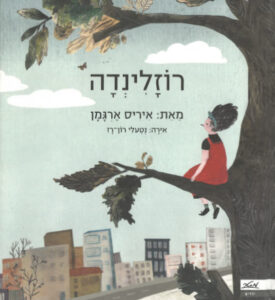
Rosalinda
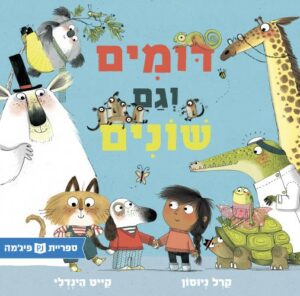
The Same but Different
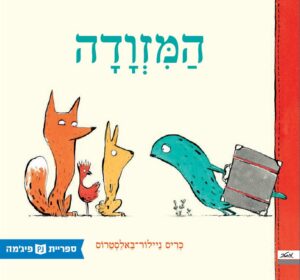
The Suitcase
Strictly No Elephants
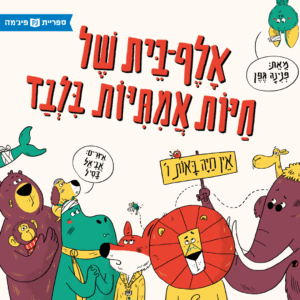
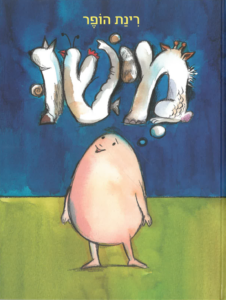
Somebody
Superbat
Good Mood Bear
The Backward Owl
The Three Butterflies