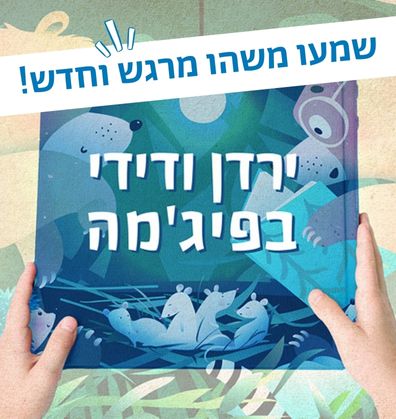
Assaf loves his tiger doll and finds it difficult to say goodbye to her. When the tiger gets lost in the kindergarten, Assaf is very worried. Soon, the children join the search for him, helping him find his best friend, and especially integrate into the game and make new friends.
Age Group: Preschool (3-5)
Book-Related Family Activities
For Assaf, as for many children, the tiger doll is much more than a doll. It provides confidence, allows you to express feelings, and helps express what is sometimes difficult to say directly. When the doll disappears, Assaf is sad, and the kindergarten children help him in his search. Through their thorough search, they teach us about empathy and listening to the other’s distress.
“Let each one desire for the benefit of his fellow”
(Rabbeinu Bachya ben Asher, Deuteronomy 22:1)
Book-Related Video
Enjoyable viewing!
Publishing:
כנפיים וכתר
Year of Distribution:
2026-2027

Where's my doll?
Choose a doll that will “get lost” around the house. Each time, someone will hide it, and the rest will go on a search with clues. For example: “The elephant is very tired, it was looking for a place to rest.”
"If he could, Assaf would roar"
Choose a different animal each time and try to think together about its special qualities and abilities. Try to imitate the animal with voice or movement. For example, get under the armor like a turtle or wake everyone up with a loud call like a rooster.
Emotional discourse with the help of a doll
Invite a beloved doll for a special conversation. You’ll ask her questions, and the kids will answer as the doll. You can ask about the things she likes to do or eat, you can ask about her feelings, and if there’s anything she’d like to tell you.
About the book
Many children use a doll or object that allows them to cope with emotional and social challenges, such as the transition between home and kindergarten. Through Assaf’s sensitive character, you can deal with the need for a transitional object and talk about meaningful objects for children. Inspired by the group of children who come to Assaf’s aid, it is possible to cultivate empathy among the children, and encourage them to help each other.
The topic of friendship and joining the game can enable a conversation about integrating into a group and a sense of belonging.
Conversation
First Reading Questions
Monitoring Understanding:
After the kindergarten teacher suggests to Assaf to leave a tiger in a drawer, and he explains that “a tiger doesn’t want to be alone”, you can ask:
Why do you think Assaf doesn’t want to leave Nimr in a drawer?
Where are the other children?
After Assaf discovers that a tiger is gone and his voice trembles, we can ask:
How does Assaf feel now? How can you know?
Prediction Questions:
After Assaf discovers that the tiger has disappeared:
Where do you think he’s gone?
When the children hear something that sounds like the roar of a tiger, before the cat is discovered:
What do you think they are going to discover?
Re-encounters with the book
Back to the illustrations:
Go back to the illustration where the shelves are arranged, and invite the children to look for clues:
– Do you see anything in the illustration that can clue to where a tiger is?
You can draw attention to the colors peeking out of the box, which resemble the colors of a tiger, and discover how the illustration adds information that is not explicitly stated in the text.
The book invites an emotional discourse on topics such as mutual aid and attachment to transitional objects:
– Have you ever helped a friend find something that was lost to him? Did they help you?
– How did Assaf feel when the tiger disappeared?
How did he feel when his friends came to help him?
– In what way did Assaf help the tiger, and in what way did Assaf help Assaf?
– Do you have a doll or object that is very important to you? What is special about them for you?
– How would you feel if they disappeared?
You should go back to the illustration in which Assaf played separately and watch it with the children. You can ask:
Where’s Assaf?
“Who did he play with?”
If we see a friend playing alone, how do we know if they want to continue playing alone or playing together?
What can I say to them or ask them?
What can you do when friends say they now want to play alone?
Introduce children to the concept of a “speech bubble” with the illustrations:
- Who’s talking?
- How do you know who’s talking?
- Who does he turn to?
- What does he say?
It is possible to explain that speaking weeks help us know what the characters are saying.
Later on, you can invite the children to “join the conversation” in the book: to think about what they would like to say to Assaf when he was looking for a tiger, and what Assaf could have answered them. You can write the children’s suggestions in speech bubbles.
Afterwards, the play can be edited: the children will choose characters from the story, recreate conversations from the book and invent new ones. During the play, you can stop and ask: What would you say to Assaf now? What can Assaf answer?
A Significant Object
Invite the children to bring objects from home that are meaningful to them, present them in the meeting and tell about them. To help the children in the play, you can send the parents a preparation sheet that they will fill out together at home.
You can take pictures of each child with their object, make a picture board or make up stories while combining several objects at a time.
The Garden Search Patrol
Hide an object such as keys or a book around the garden and tell the children that, like Assaf, you too have lost something important and you need their help in the search.
Once the object is found, you can compliment the children for calling for help, and announce the kindergarten’s “search patrol”, which will be activated whenever someone loses something.
Lost Found Box
Bring a cardboard box, explain to the children that this will be the kindergarten’s reality box – and whenever someone finds something that doesn’t belong to them or the kindergarten, they can put it in the box, and anyone looking for a specific object will know where to turn. Offer the children a variety of materials to decorate the box as they wish.
Following the illustrations
You can delve deeper into the illustrations in small groups, in which each child holds his own copy. You can reconstruct the story with the illustrations, let the children look for small details they identify and compare – what is in the kindergarten in the illustrations, and what is in our kindergarten? What similar details do we find?