הגבול העדין שבין אמירת האמת להסתרתה ובין המצאה למציאות, הוא גבול שמעסיק ילדים וילדות בגיל הרך, ונוגע בהתמודדויות חברתיות ורגשיות, ובתהליך התבגרות טבעי. את ההתמודדויות האלו יכולים ללוות ספרים שעוסקים בנושא, בעדינות וברגישות וגם בשעשוע ובהומור.
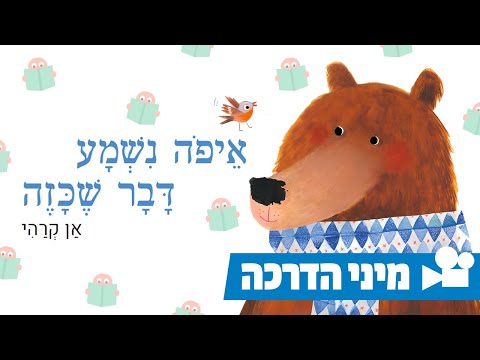
You can discuss the meaning of the word “rumor” – what is the difference between things we heard from others verus things we know happened? You can share instances in which you encountered a rumor. How did you respond? How did it make you feel? Were you able to refrain from telling others? What will you do next time you come across a rumor?
Like the bear and the finch, you can also have family teatime during which you can share stories and experiences that happened to family members throughout the day. You can take the bear’s advice and share stories and experiences that are true, good, and useful.
Do you know this well-loved game of passing a sentence on from one player to another by whispering it in their ear? Now try the riddle version – take turns being the first player who whispers a sentence describing one of the forest animals, for instance: I climb trees and crack nuts. The last player in each round will have to guess which animal it is.
The illustrations contain tiny, interesting details to which you can pay attention each time you read this book. You can discover which animals appear on each page besides the finch. What, in your opinion, are the other animals looking out of the window doing? The final page shows an illustration that is not accompanied by any text. Try to imagine what story the bear is telling the finch.
Talk with your children and ask: How do you feel when you fight with a friend or family member? How do you both behave during a quarrel? Can anything help you reconcile? How can we help friends who are fighting reconcile?
This book can inspire you to take two puppets, toy cars, or any pair of items; you can even put a pair of socks on your hands. Invite your children to imagine and make up a “real fight” – what are they fighting about? How do they reconcile? Do they reconcile on their own or do they need help doing so? Now you are ready to put on a show.
Hyraxes and ibexes are desert animals that live in Israel. This book provides a wonderful opportunity to explore and discover! What do they look like in real life? What characterizes them? What do they enjoy eating? What other interesting facts would you like to know about them?
While you read, you can use different voices and invite the children to do the same: What does a person sound like when s/he bursts out crying? What does a hole being drilled into the wall sound like? Even if you’re not professional actors or actresses, your active participation in the story will enhance your shared experience and delight.
The judge learns from the girl how to resolve the case brought before him. Following this book, you can discuss your children’s knowledge and strengths with them: It can be a hobby, insight or shared memory from an incident in which they contributed their experience and wisdom. You, parents, should also share: What have you learned from your child?
Do oil droplets indeed float in water? You can see for yourselves by adding a few drops of oil into a bowl filled with water. You can later check what else floats: What happens to a piece of paper in water? Or a paper boat? A fork? Or a leaf? And how about a small plastic toy?
Just as they do in this book, you too can try to resolve a disagreement on some issue: Each party presents their case, everyone listens, and suggests how to resolve the dispute.
You can also swap roles and explore together – is only one of you right? Or can you, perhaps, reach some other kind of understanding?
Telling and listening to stories is great fun. The shared experience makes everyone feel good. Discuss and think together – when is the right time for story-telling and letting your imagination run wild. When is it best to tell the story like it is — without adding or leaving out any details? Who would you feel comfortable confiding in when you face dilemmas?
Who can remember what happened yesterday? Can you tell it like a story? You can use this opportunity to share experiences. You can also play: One of the participants will tell a story, while the others try to figure out what is true and which parts are made up.
Whenever Shahar wants to share or consult, she sits on the bench with Herzl, the security guard, and he always listens. Choose a spot at home where you can always speak and be heard. Whenever you need to share, sit there, tell your story, and seek advice.
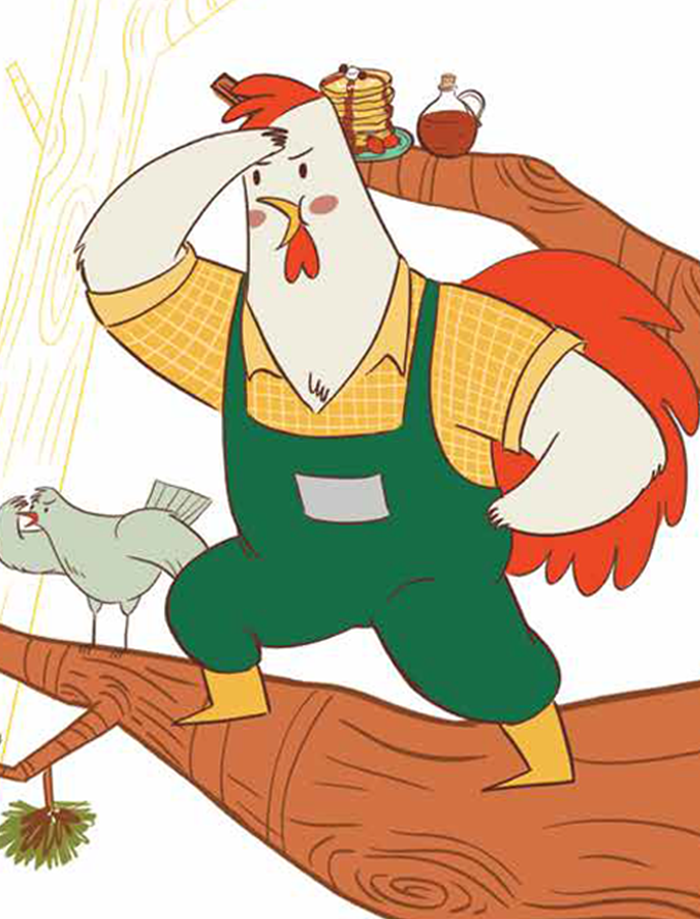
Perhaps you would enjoy discussing and sharing the following: What do you think makes a person wise? Can you think of an incident in which someone behaved wisely? Was the fox wise, or the rooster? Perhaps they bother were? Or maybe neither one was?
Having read this book together, you, parents, may want to tell a story, and ask the others to decide whether the story you’ve told actually happened or was a work of fiction. Next, ask your children to share their own stories. This may be a good opportunity to share unusual incidents with one another, and laugh together.
What does the name Ram-Kol (Loud-Speaker) tell us about the rooster? Can you come up with names for yourselves that reflect a special, good quality that characterizes you? Perhaps the rest of your family can help!
In the story, Nivi’s emotions are depicted as bumper cars in an amusement park. On a repeated reading of the book try to follow with your child when the bumper cars crash into each other. When do the bumper cars stop bothering her? Why?
A chain of bad deeds versus a chain of good deeds. Talk to your child: What is Nivi’s first mistake? What are the consequences? In what way does one bad deed lead to another? What is the first step she takes to correcting her mistake? What does that lead to? In what way does one good deed lead to another?
The turning point in the story is when Nivi acknowledges her mistakes. The process she undergoes is one of correction, repentance and forgiveness. The notion of Tikkun (rectification or correction) is a basic concept in Judaism. Judaism assumes that every one of us sometimes makes mistaken choices but that we all have the power to rectify ourselves, and change course for the better. There are many Jewish sources that guide a person and his surroundings on how to rectify wrongdoing. The great 12th century Jewish sage, Maimonides, guides a person to first acknowledge a wrongdoing, to repent genuinely, and to resolve not to repeat the action. He also teaches that the person who was wronged must forgive the wrongdoer who asks for forgiveness.
Look together at the pictures in the book and suggest that your child tell the story in his/her own words. Look for the pictures depicting the moments of asking for forgiveness and giving forgiveness in the encounters among the characters (Nivi, Mother and the teacher). (You may well discover new ways to understand the story through what your child tells you. Pay attention to what details your child considers important and which ones he/she does not think are important).
Tell your children if you sometimes did things that were not allowed when you were a child. Did you correct the wrongdoing? How? Try to create a story dealing with asking and receiving forgiveness. Consider drawing it and creating your own little book.
Talk with your child about whether he/she has ever experienced a similar situation.
You may want to look at the illustrations together, and look for the disguised animals mentioned in the story. Can your child recognize them all? Who, in your opinion, has the best costume? To whom would you have awarded the prize?
Make costumes and masks for your stuffed toys, set a table with fine food, and sing Purim songs together. Who will win the costume competition, and what will the jackpot be?
You may want to stop reading for a moment at the point where the animals argue, each one thinking it had the best costume, and ask your child to describe the decision-making process for which they would have opted. You could use this book as a platform for discussing achievements, competition, and the feelings associated with winning and losing.
You may want to discuss the fox’s behavior with your child. Did he deserve to win the costume competition? The fox is portrayed as cunning in many stories. Do you know any other books on foxes, such as The Fox and the Grapes, The Chickens and the Fox, or Fox Fables? You could search for them and read them together.
Do you remember a special childhood costume? You may enjoy sharing childhood experiences related to Purim and dressing up with your child. You could also look at family photo albums, and be reminded of parents’, siblings’, and children’s past costumes.
is the author and illustrator of many children’s books, among them: A Smile on every Corner, The Melody, and Oded Burla’s Big Book. You may want to look for more of his books at the library, and enjoy them together.
You don’t need to know how to read to figure out what’s going on in these comic strips! Your children can “read” the pictures and tell the story in their own words.
Even young children can draw a comic strip. Ask them to choose a story they know and create a comic strip out of it.
Mr. Fibber the Storyteller uses his imagination to invent impossible tales. Children, too, can make up wildly exaggerated and imaginative stories. Together with your children, you could work on creating your own imaginary tale. One of you could begin: “One morning, I was on my way to kindergarten when I saw (fill in the blank)…” The next person might continue the story line with: “…when suddenly, I came to…” At the end of the story, you could select one of the imaginary situations you concocted together, and make illustrations for it.
What makes you laugh? After you read these comics—maybe close to the Purim holiday—you could host a Family Joke Night.
Do you know other books by Leah Goldberg? You might look for her stories and poems at your school or library, so you can read and enjoy them together. We hope you enjoy reading and talking about this book!
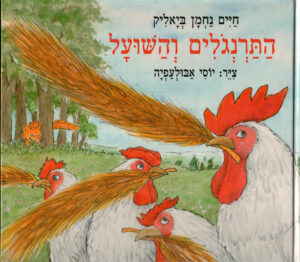
Follow the worm to tell the story: A little worm is hiding in the illustrations on each page of the book. It accompanies the flock of chickens on their journey to find food and watches what happens. Look for the worm. (You may give hints to children who have difficulty in finding it.)
You might want to use your finger as a “puppet” that talks to the worm about what it sees. You can even draw a little face on your finger and “befriend” the worm.
At the end of the story the chicken and the fox meet. Look at the illustrations that depict their encounter. Notice the facial expressions of the chicken and note what happens to the fox’s tail. Taking an idea from comics, cut out six “conversation balloons”. Using a bit of masking tape attach the “balloons” to the illustrations of the chicken and the fox. Inside each balloon write what the chicken said to the fox and what he answered her. (Parents: Use as little masking tape as possible in order to protect the book.)
We part from the brave chicken as she watches the fox run away. In the distance you can see the flock of chickens. They still don’t know that their little friend has saved their lives! It would be interesting to imagine what they do when they learn what occurred. You can act out the meeting between the wounded chicken and her friends by putting on a puppet show. You can make the puppets from cloth material, from boxes or from drawings cut out and pasted to wooden sticks. You can even include the “hidden worm” as the narrator of the story.
It is very difficult for the chicken to walk. She can’t even manage to hold a stalk of grain in her beak like the others. But when the fox threatens her, she turns her weakness into strength. This is her “hour”. Tell or draw a true or imagined story about someone who has his or her shining “hour”, an event that changes them from someone who is weak into someone who is strong.
The chicken has one weak leg. That’s why she needs the help of a crutch. Do you know a person or an animal that has a physical weakness? Discuss with your children what can help those who have trouble moving, hearing or seeing. Look for such examples in your neighborhood (special parking places designated for the handicapped, sign language for the deaf on news programs, floor numbers in an elevator embossed in Braille, etc.).
There are even special bills of money that are particularly suited for people who have difficultly in seeing. Look at two different bills of money of differing denominations. Close your eyes and feel the bills, and you will discover a protruding sign that helps people with poor vision “read” the bills and differentiate between them.
Throughout the story “The Chickens and the Fox”, Bialik provides hints to stories of our forefathers in the Bible:
The flock of chickens leaves its dwelling place during a year of drought and hunger and arrives at a place where there is food. Once they have satisfied their hunger, the leader gathers them together and asks them to quickly organize themselves for their journey homeward. They are going back to their coop. On their way home a fox lays in wait for them. Like Amalek, he doesn’t dare attack the main group of the flock, but aims instead at the weak straggler at the tail end of the camp.
As opposed to the fierce battle in the desert with Amalek, our chicken succeeds in frightening the fox. She does this by telling him that he who plans to harm the “tail of the camp” will lose his own tail. The fox is alarmed by this and flees, and thus the story ends with the chickens winning the day.



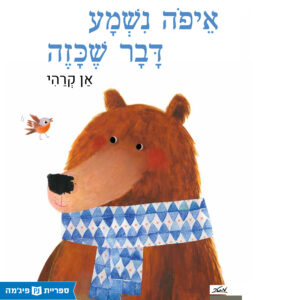 The Bear and the Finch
 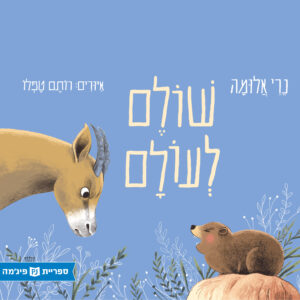 Peace to the World
 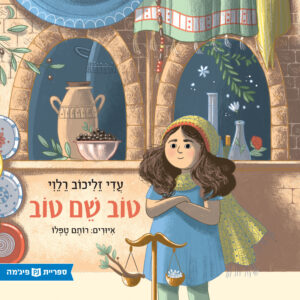 A Good Name
 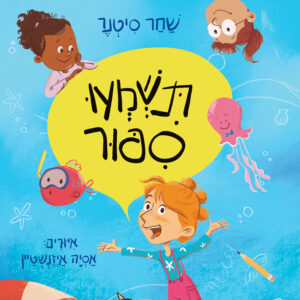 Let Me Tell You a Story
 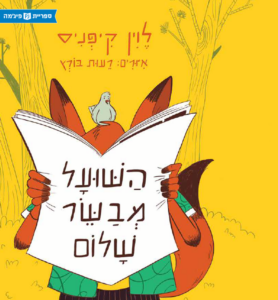 The Fox Announces Peace
 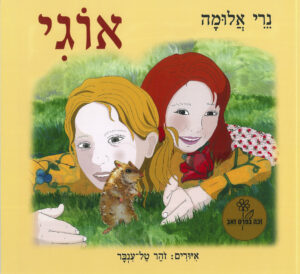 Ogi
Ogi 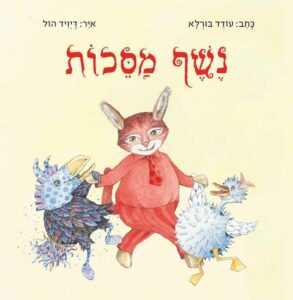 Masquerade
 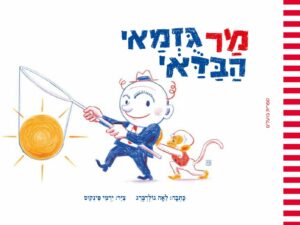 Mr. Fibber the Storyteller
  THE CHICKENS AND THE FOX
  שִׂיחָה
 מִשְׂחָק
 קְרִיאָה
 סִרְטוֹנִים
 הַשְׁרָאָה
 שֵׁמַע
 חֵקֶר
חֵקֶר כְּלָלִי
 חֲגִיגָה
 הַעֲשָׁרָה