עבור ילדות וילדים, כל חג הוא הפתעה. החג נקלט באמצעות החושים ונשאר כזיכרון ילדות מתוק לאורך שנים קדימה, בליווי השירים והסיפורים אשר עוטפים אותו במעטפת המנחמת של המוכר והטוב. הלבוש המיוחד, הצלילים והשירים, הטעמים והריחות - כל אלו יוצרים את אווירת החג בתפיסת עולמם של הילדים והילדות. דרך הסיפורים אפשר לשוחח ולהיזכר בחגים השונים ובחוויות שהביאו איתם. קריאת ספרים שעוסקים בחגים היא דרך מצוינת לחג ולעיבוד החוויות לפניו, במהלכו ואחריו.
Getting ready for Purim: Toddlers are introduced to holidays and traditions early on in life. This book touches on the custom of dressing up for Purim which can make various feelings surface. With the help of this story, we can familiarize ourselves with this custom, visualize the Purim party at daycare, and discuss it. Doing so in advance may evoke curiosity and excitement, lessen concerns, and help toddlers be better prepared.
You can look at photographs together – pictures of your toddlers and other family members from previous Purim celebrations – to be reminded of and share childhood stories. You can ask questions such as: What makes costumes special? What sets them apart from our regular clothes? How do we feel when we dress up?
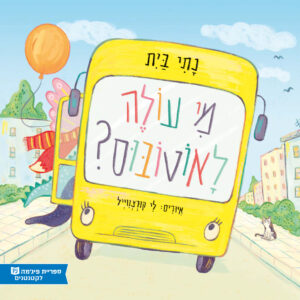
Look at the party illustration together in which all the children are dancing around in a circle. You can point at the various characters (“Here’s a strawberry”) and describe them, while noting at which station they had boarded the bus. During re-readings, you can notice whether the costumes have any special accessories and look for other interesting details.
You can play together – taking turns being the driver and picking up “passengers”, whether they be family members, stuffed animals and dolls, and other items from various “stations” around your home. And what should you do once you get to your final destination? You can disembark and throw a dance party!
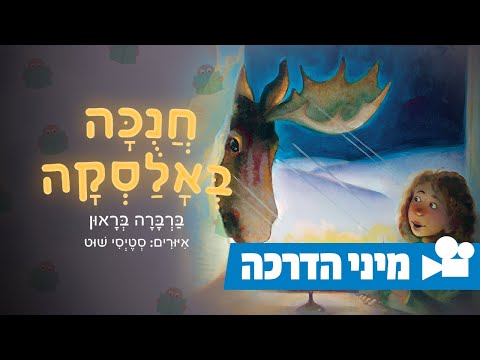
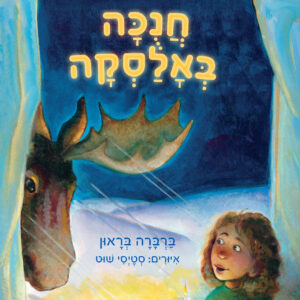
Hanukkah has been celebrated by Jews worldwide throughout the generations. You can discuss your own Hanukkah family traditions – Do you have any special customs? Are they similar to the Hanukkah customs commonn in Alaska? Have you ever celebrated Hanukkah in an unusual situation or extraordinary location?
This book can inspire you to take an evening stroll and look at the lights around you: the stars, moon, street lights, and perhaps even the menorahs that others have lit – how many lights do you see? For every source of light you discovere outside, mention one thing that makes you happy, stronger, or spreads the light in your life.
Where would you like to light Hanukkah candles today? Somewhere special in Israel? How about in snowy Alaska? You can make a world map and play an amusing game in which you pretend to light Hanukkah candles in a different location each day! What can you see around you? What will you be eating besides latkes and doughnuts? Which local customs will you incorporate into your holiday?
Books on customs, symbols and holiday dishes enrich the holiday experience, helping to develop anticipation and curiosity before it arrives. This book should also be read together with your toddlers during the holiday, and even when it is over – so that, together, you can think back on the beautiful moments, melodies, colors, flavors and scents.
Lea Naor was born in Herzliya in 1935.
Every time you read this book, try looking for new interesting details in its illustrations – Where’s the parrot? What is it doing in each of the illustrations? What are the father and children doing? Which items and ingredients are on the table? And which objects do you recognize in the kitchen? Perhaps you can also find them in your own home and kitchen.
While making latkes, or any other of your favorite foods, you can take pictures of the preparation process. These pictures can later be incorporated into a small photo album that will help you repeat the correct steps, as well as the names of actions and ingredients.
A recipe for latkes
Ingredients:
5 potatoes
1 large onion
2 eggs
Half a cup of flour
Half a teaspoon of sugar
1 teaspoon of salt
Frying oil
Method:
1. Peel and grate the onion and potatoes. Squeeze out all the fluids, and place in a bowl.
2. Add the rest of the ingredients – the eggs, flour, sugar and salt (as well as other condiments, if you so wish) – to the bowl, and mix them well.
3. Fry the latkes carefully in hot oil (one to one and a half tablespoons for each latke) until golden on both sides.
This book is a gift that can accompany you as a family throughout the year: on festive holidays and in changing seasons, with the arrival of Autumn and in preparation for a birthday celebration. Choose the appropriate song for each coming occasion or holiday, read it together, look at the illustrations, sing and celebrate. Poems and illustrations Read the songs together and look at the illustrations. Which illustrations attract the children’s attention?
Many of the songs in this book were composed to music. You can take a cymbals, wooden spoons or lids of pots and pans, and accompany the singing by playing music and dancing. Once the children are familiar with the song, you can play a guessing game: starting humming the tune, and invite the children to guess the rest and join you.
Open the book randomly, or at a favorite song, and let each person in turn name an item that everyone else must look for in the illustration: Find in the illustration: Where is the house with a red roof? Where is the pomegranate? Where are the clowns?
was born in Alexandria, Egypt, in 1944, and immigrated to Israel at 12 months. At the beginning of her professional career, Ben Dor engaged in music education, writing scripts and songs for many Israeli children’s television shows, such as Parpar Nechmad (“Lovely Butterfly”), and Rehov Sumsum (the Israeli version of Sesame Street). Her children’s poems and numerous books are well-known and loved, among them Ani Tamid Nishar Ani (“I Always Stay Me”), Digdugim (“Tickles”), Otiyot Mefatpetot (“Chatting Letters”), and Kakha Zeh BeIvrit (“That’s How it is in Hebrew”). Datia Ben Dor has received much recognition for her contribution to children’s literature, such as the ACUM award, and Bialik Prize for Lifelong Achievement in Children’s Literature.
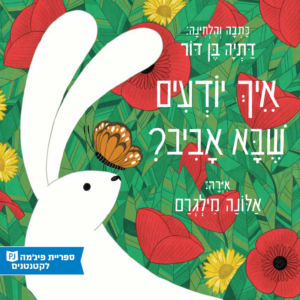
Can your child find Passover symbols in the illustrations? Perhaps you could ask them to point out the four cups, matzah, Passover Haggadah and wine. You may also want to look for clues that spring has arrived – short-sleeved shirts and shorts, flower bloom, and clear skies.
Do you know the tune to this song? How about singing it together, dancing round and round?
Springtime beckons us to go outside and enjoy nature. Where do you like to be when you are outdoors? Perhaps you could take this book along with you, take a stroll near your house, and look for signs of spring together.
You may want to make “spring binoculars” and look through it all around. Decorate two toilet paper rolls with stickers and crayons, and attach them to one another on their long side. What can you see through your binoculars?
Ma Nishtana? What has changed in your home in preparation for Passover? Young children can also take part in preparing for the holiday, and particularly Seder Night. Perhaps you could invite them to help you set the festive table, sing Passover songs, ask the Four Questions, and look for the Afikoman, of course!
Datia Ben Dor has written many well-loved poems and stories for toddlers and preschoolers. You may want to look for them at home or in the library, and read them together.
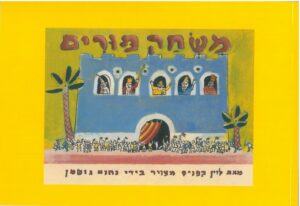
You may enjoy looking together at Nachum Gutman’s special, 80-year-old illustrations. Have you noticed that all the characters in the book, even the horse, are children in costume? You could make simple animal costumes at home using paper or foam sheets to create ears, belts for tails, or any other similar idea. Now the kids can crawl on all fours and turn into neighing horses, barking dogs, bleating sheep and so on.
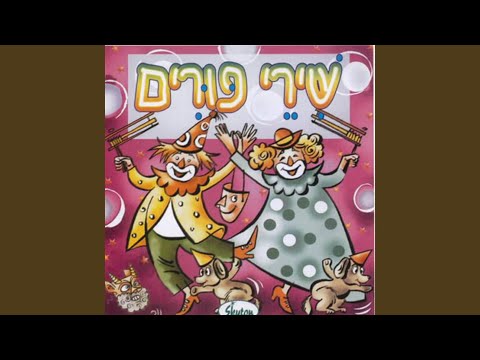
Do you know the tune to Purim Play? You may want to listen to the song, clap along to the music, or accompany it with your own instrument, and dance together.
Many children love to dress up, and not only on Purim! You can make costumes at home using clothes, colorful kerchiefs, and simple accessories found in every home. How about making paper crowns and tiaras, or clown’s hats, and having a family costume party?
Do you remember a particular Purim costume from the time you were a child? Did you also dress up as Mordechai or Esther? Have you saved photographs from previous years? You may want to share those with your child.
You could tell your child about the custom of sending each other Purim baskets of food. You may want to prepare such a basket at home, placing pastries, fruit or candy on a pretty napkin, and give it to your neighbor, friend, or favorite babysitter.
Levin Kipnis was one of the founding fathers of Hebrew children’s literature. He was born in the Ukraine and immigrated to what would later become the State of Israel in 1913, with the aim of studying painting at Bezalel. However, upon feeling that there were not enough holiday songs and stories in Hebrew suitable for young children, he decided to dedicate his life to enriching young people’s world. He wrote hundreds of children’s poems and stories, and even decorated and illustrated some of his own work. Kipnis set up and managed the first children’s theater in Israel, and also edited numerous journals, anthologies and text books. His collaboration with kindergarten teachers contributed greatly to the shaping of Israeli holiday traditions. Among his numerous works are well-loved songs and stories such as Svivon Sov Sov Sov (“Spin Spin Spin, Dreidel”) for Hanukkah, Saleinu Al Ktefeinu (“Our Baskets are upon our Shoulders”) for Shavuot, Eliezer Vehagezer (“Eliezer and the Carrot”), and Hamitriya Hagdola shel Abba (“Daddy’s Big Umbrella”).
Levin Kipnis was a particularly prolific author, and won many awards, including the Israel Prize in 1978, and the Hans Christian Andersen Award in 1988.
Nachum Gutman was a master painter, illustrator, sculptor, and author. He was regarded as a trailblazing children’s illustrator in Israel, having illustrated children’s poetry by Bialik, Tchernichovsky, and others. Gutman illustrated stories, poems, and articles in the children’s weekly magazine Davar Liyladim, and designed many stage sets. He even created the colorful figures and sets for the famous Tel Aviv Purim Parade (Adloyada). Nachum Gutman wrote books for both children and adults, such as In the Land of Lobengulu King of Zulu, An All Blue Donkey, and A Small City with Few People, describing the early days of Tel Aviv.
Gutman won many awards, including: the Hans Christian Andersen Literary Prize in 1962; the Fichman Prize for Literature and Art in 1969; and the Israel Prize for his contribution to children’s literature in 1978. The Nachum Gutman Museum, showcasing the artist’s original work, opened in the Neve Tzedek neighborhood of Tel Aviv in 1998.
תוכלו לספר לילדים על המנהג לשלוח מנות של אוכל בחג פורים. אתם יכולים להכין בעצמכם צלחת, לקשט אותה במפית יפה ולהניח עליה מאפה, פרי או ממתק, ולהעניק את המשלוח לשכ־ נים, לחברים או לשמרטפית אהובה.
כדאי לעיין בכריכת הספר, הדמויות באיור מציצות מתוך חלונות הארמון. תוכלו לקשט תיאטרון בובות או להכין ארמון מקרטון, עם פתחים מקומרים כמו בתמונה. כל ילד בתורו חובש כובע, כתר או מצנפת, מציץ מהחלון – וחבריו מנסים לנחש למי הוא התחפש.?
לכל דמות בספר יש כובע ייחודי משלה. בעקבות האיורים תוכלי להכין מצנפת )לליצן(, כתר של מלך )אחשוורוש(, כתר של מלכה )אסתר(, כובע מיוחד בצבע תכלת )מרדכי(, כובע מצחיק )המן(. כאשר שרים יחד את השיר, מחליפים את הכובעים בהתאמה למילות השיר.
תוכלי להכין עם הילדים משלוח מנות ספרותי: הילדים יכולים להדביק על צלחת תמונות עם דמויות מתוך הספרים שקיבלו השנה )החיות שמופיעות בספרים הקודמים וגיבורי “משחק פורים”(. מלאו את הצלחת במאכלים והוסיפו אליו את הספר כמתנה לחג.



 Who Gets on the Bus?
  Hanukkah in Alaska
 ![כריכת הספר What? What? A Potato! [Mah? Mah? Tapuah Adamah!]](https://www.pjisrael.org/wp-content/uploads/2024/04/מה-מה-תפוח-אדמה-כריכה-על-ריבוע-לאתר-300x300.jpg) What? What? A Potato! [Mah? Mah? Tapuah Adamah!]
What? What? A Potato! [Mah? Mah? Tapuah Adamah!] 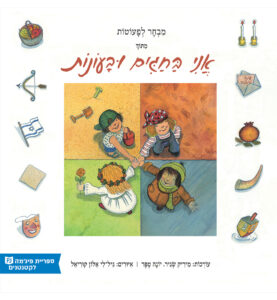 The holidays, seasons and me
  How do You Know that Spring has Come?
  The seven species
  Purim Spiel (A Purim Play)
  קְרִיאָה
 שִׂיחָה
 מִשְׂחָק
 שֵׁמַע
 לָצֵאת הַחוּצָה
 יְצִירָה
 הַשְׁרָאָה
 בִּשּׁוּל
 סִרְטוֹנִים
 הַעֲשָׁרָה
 כְּלָלִי
 חֲגִיגָה