מְקוֹרוֹת וְתַרְבּוּת
ארץ ישראל

הנופים, השבילים, הטיולים, חגיגת העצמאות – הם אשר יוצרים את החיבור ואת הזיקה בין הילדים לבין ביתם, ארץ ישראל. אל סיפורים נהדרים שעוסקים בנושאים אלו, מתווספים סיפורים על הגעגועים ועל הכיסופים למולדת, אשר טווים חוט של אהבה ושל שייכות למקום בקשר בין דורי.
סְּפָרִים
Book-Related Family Activities
One “Language” at Home – Another in Kindergarten
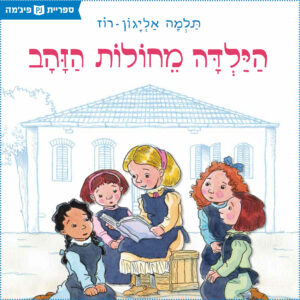
This book exposes children to an exciting period in history, and invites a discussion of their feelings in day-to-day situations. You can discuss with your children and ask: Why was Milka concerned and indecisive on the night before Baron de Rothschild’s visit? What do you think of the choice she made? Are there rules in kindergarten that differ from the ones you have at home too? Which ones?
How Do We Say it in Hebrew?
to the page containing the words that Mr. Yudilovitz, the teacher, sent to his friend, and try to pronounce them, or even use them in a sentence: “Can you pass me the Handtuch, please?” How about thinking together about all the non-Hebrew words we use in our daily lives and what their Hebrew alternatives are? You can try to invent new Hebrew words together too.
Looking for the Donkey
Have you noticed the grey donkey that appears in almost every illustration? The illustrations in this book are full of details, color, and text. You can pause on each page, look at the illustrations, and discover the things that interest you, while searching for the little donkey that accompanies this entire story.
Listen to the Story
Would you like to hear Milka speak Hebrew? Scan the code and listen to this book on the Sifriyat Pijama podcast.
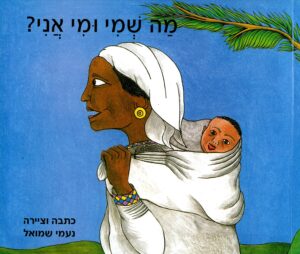
By which to remember where you came from
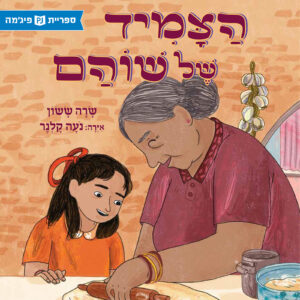
After reading this book, you can discuss the importance of family. Share memories of intimate and special moments shared with grandparents. You can discuss your family’s roots, cuisine, and culture, as well as any heirlooms and items that are passed in your family.
My Own Special Reminder
Do you also want to have an item to remember things by and help you overcome difficulty and loss? You can use beads to make a necklace or bracelet, paint a pebble, or any other good idea, and then decide what to do with this it to be reminded of something or cheer up: Twist it? Squeeze it? Stroke it? Move it to your other hand?
Homemade Cookies
Which cookies remind you – the parents – of your childhood home? This book can inspire you to bake cookies together, or prepare any other dish that connects you to your roots, family, and home.
Listen to the Story
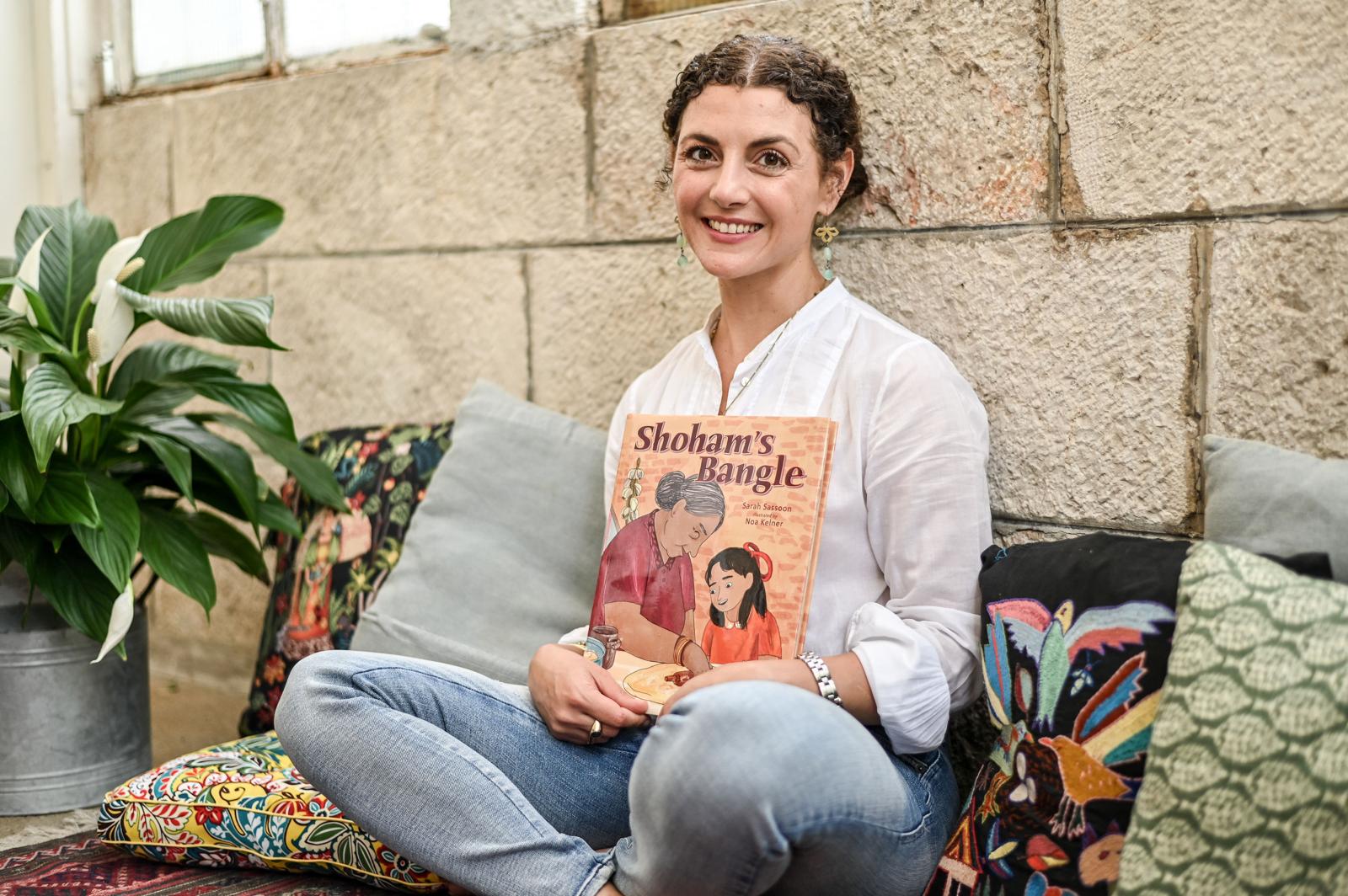
Listen to Yarden and Didi tell the story of Shoham’s Bangle on the Sifriyat Pijama podcast.
Arts & crafts, songs, and other activities can be found on the Sifriyat Pijama Pinterest page.
Family reading advice
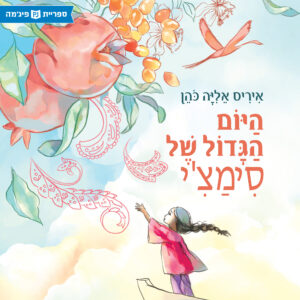
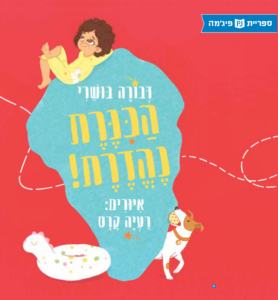
Simachi’s Big Day is a long book. We therefore recommend reading it in two parts, pausing at the point where Simachi wonders why her brother, Avram, is dressed in his best clothes, and reading the rest the next day.
Memories
In this book, Grandma is recalling her childhood memories. This is your chance, as parents, to share special moments from your own childhoods too. Talk about the things you did, those you never thought you would do, or the relationship between you and your siblings. Ask your children: Can they recall special things they did and, looking back, surprised them because they made them discover their own abilities?
Listening to Simachi
What does the story sound like? Scan the code and listen to the story while looking through the book.
A pineapple on my head
Avram and Nemi play a game by walking with a pineapple on their head and seeing who lasts longer without dropping it. You can also play a similar game: choose an item that you can put on your head – a pillow, toy or box, and find out: Which of you can walk while keeping it on your head? And how far?
Following the sea
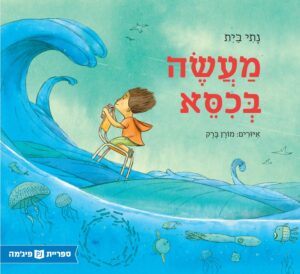
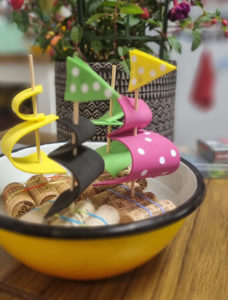
The book describes many seaside activities: the fish moving, rowing, swimming, bringing fishnets in, sailing or flying a flag on the boat’s flagpole. You can choose one of these activities, and mime it. Your family will need to guess which activity you meant, and look for it among the book’s illustrations. Good luck!
A discussion on old wives’ tales
Stories about grandparents’ own childhoods, stories about the items they had that are no longer used, or perhaps some other story? – Following this book, you may want to sit and talk to your grandma or grandpa, and hear stories about the past from them.
Listening to a story
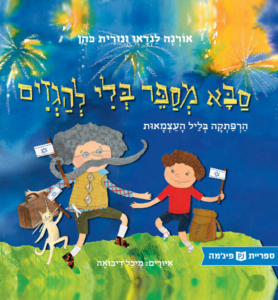
Would you like to hear Grandpa tell this story? Please scan the QR code and listen to this book, with a few exaggerations.
A game of “The best”
Grandpa has the loudest laugh and the most interesting stories, and what are you “best” at? – Take turns talking about yourself, and saying what you do best. Next, take turns talking about the person sitting next to you, and what they’re the best at – but only the good things!
Dancing in a circle
Why is everybody dancing? Because the State of Israel was established, and it’s a great reason to dance! Do you know how old Israel is now? How many years ago was it established?
Perhaps you would also like to dance together to the music, and dedicate a dance to someone or something that has happened.
A little advice for family reading
Children “read” illustrations, and notice details that do not appear in the text. You could join them while reading by looking at the illustrations too, and discovering how they add interesting, surprising details to the written story, perhaps even telling another one in lines and color.
A discussion on travel through photographs
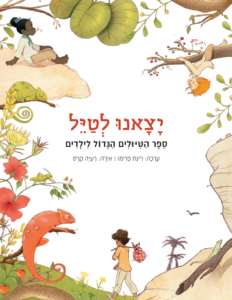
Where have you traveled to, and where would you like to go? You may enjoy looking at family photos together, and reminding one another of trips you have taken, and your favorite spots to visit. Have you found a place to which you have yet to travel, and would like to go to in future?
Singing to the Sea of Galilee
In Hebrew, the Sea of Galilee is called Kinneret, and it is featured in a well-known song by the name of Shiri Li Kinneret [Sing to Me, Sea of Galilee]. Would you also like to sing the Sea of Galilee a song? Scan the QR code and sing along!
Who or what is in the illustrations?
Is it a buffalo? A fox? A sea turtle? Look closely at the illustrations and get to know animals that live in various parts of Israel. You, parents, can say the name of the creature, and help your children find it in the book. You could also suggest that your child look for more information in additional resources, and increase their knowledge on the various animals.
A game of “Land, Sea (of Galilee)”
Place a piece of rope on the ground and decide which side of it is the Sea of Galilee and which is the land. One player will call out “Sea of Galilee” or “Land”, and the others will jump to the correct side. You can even add names of animals, for instance, “Sea of Galilee Duck”, and then jump to the Sea of Galilee side while quacking.
A discussion on stories that “once were”
Following this book, you could also raise memories and tell stories that “once were” – a childhood story of yours, parents, or one told by Grandma or Grandpa about the old days.
Listening to the story
You could listen to the story together or separately; all you have to do is scan the QR code and… let the magic begin!
Suitable for families of Olim too.
Look how we have grown!
The tree grew, as did Rebecca. And how about you? Perhaps you would enjoy watching videos and looking at photographs to see how both children and parents have grown and changed. You could even discuss the kinds of actions that your children were able or unable to do in the past.
Orange sponge cake
Would you like to bake a cake? All you need are two eggs, one third of a cup of sugar, one third of a cup of oil, half a cup of fresh orange juice, a cup of flour (or substitute) and one teaspoon of baking powder. You could also add the grated zest of half an orange.
Mix all the ingredients in order and place in an oven preheated to 180 degrees Celsius. Bon Appetit!

Discussion
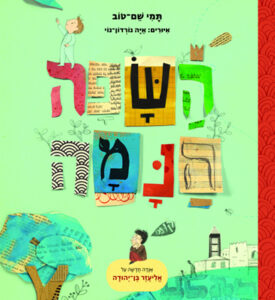
You may want to discuss your experience of acquiring Hebrew: What were the first words you said as toddlers? Did you invent any words? Do you, parents, know what the first words you said were? Did you acquire another language? If you learned to speak Hebrew at a later stage, you could discuss the experience of learning the language, and discover what language you speak when you dream at night.
A family dictionary
Which word does your family like, and why? Are there any words that you have invented, and only your family members understand? Perhaps some of those words have a special story behind them? You may enjoy collecting stories from family members: a word of friendship, a special term of endearment, or secret family codeword.
Name, place, animal, thing (a game)
In Hebrew the game is called Chai, Tzomeach, Domem (animal, vegetable, thing). Select a letter, and participants must name animals, vegetables and things starting with the letter selected.
Haftaa [surprise], boreg [screw], glida [ice cream]
Rakevet [train], mapuhit [harmonica], and kruvit [cauliflower] are just some of the words that Eliezer Ben Yehuda invented. Others appear on the second to last page of this book. You could take turns to choose two words from this page and use them in a sentence: a sentence containing the words haftaa [surprise] and ganenet [kindergarten teacher], or ganenet [kindergarten teacher] and tizmoret [orchestra], or how about tizmoret [orchestra] and nazelet [nasal mucus]? Do you think you could put a small story together featuring all the words on this page?
The revivers of the Hebrew Language
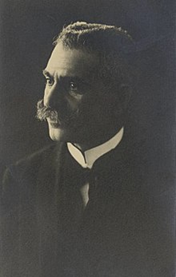
Rabbi Yechiel Michel Pines (1843–1913) was involved in the purchase of lands, setting up the Academy of the Hebrew Language with Eliezer Ben Yehuda. Rabbi Pines invented new Hebrew words, such as agvania [tomato] and shaon [clock/watch].
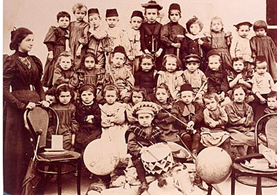
Nissim Behar (1848–1931) founded the Torah Umelacha School in Jerusalem where Hebrew was taught in Hebrew. Eliezer Ben Yehuda was a teacher at this school.
Hayim Nahman Bialik (1873–1934) – the national poet was a key activist at the Academy of the Hebrew Language, inventing professional terms in fields such as music and the playing of musical instruments. Matos [airplane], matzlema [camera], and etzbeoni [thimble] are some of the words he invented.
Many others actively contributed to the revival of the Hebrew language. You could learn more about them by visiting the Academy of the Hebrew Language website.
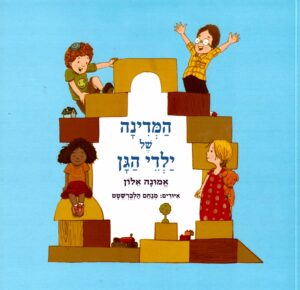
האזינו לסיפור המדינה של ילדי הגן
אנו מזמינים אתכם/ן להאזין לסיפור “המדינה של ילדי הגן”, מאת: אמונה אלון | איורים: מנחם הלברשטט | הוצאת: ידיעות ספרים (גנים)
יוצרים ומגישים – ירדן בר כוכבא – הלפרין ודידי שחר
מוזיקה ונגינה – טל בלכרוביץ’
פתיח – דידי שחר
מגישים – יובל סגל, אפרת אביב ותומר שרון.
אקורדיון וחלילים – סלעית להב
מוכנים/ות? מת – חי – לים!
Family Activities
Menachem Halberstadt’s wonderful illustrations speak to the adults reading the story as well as the children, and hint at well-known historical personae and experiences. Even the teddy bear is wearing a hat from the days of the Palmach! Look closely at the illustrations together with your child and share the country’s history with them. See if you can find pictures depicting Theodore Herzl, David Ben Gurion, and dancing the hora in the streets of Tel Aviv.
Adi points to some pictures of famous photographs depicting stories of immigrants. Ask your child to show you these pictures and try to guess from which countries the different immigrants came. You can take out an atlas or map of the world, and look for the places where your family lived throughout the generations and where you have relatives outside Israel today.
The children in the story act out an imaginary version of “building the country”, which initiated in the make-believe corner of the kindergarten. Your child can also dress up in costume and choose a task in building the country.
You too can “build a country”. Let your imagination run wild: How will you call your country? Who will live in it? Which buildings are needed? Will it have a flag? You are invited to send us a photograph of the country you created, and we’ll post the picture on the Sifriyat Pijama website pj.crunchcart.com .
It is not always easy to join in to an existing group and find your role in it. The story can provide an opportunity for you and your child to discuss the emotions of the characters in the book, and for you to share with them your own life experiences – in your personal life, and on the national level.
The building of the State of Israel is a process that has not come to an end, and more new immigrants are likely to join the country in the future. David, the new oleh in the story, brings a toy plane with him to the game. What would you propose new immigrants bring with them to continue building and improving the state?
A number of well-known songs greet new olim as they arrive in Israel. You can organize a sing-along one evening in your home and sing such favorites as “Heveinu shalom aleichem”, “Am Yisrael Chai”, and “Hineh ma tov u ma na’im”.
The Girl From The Golden Sands
Shoham’s Bangle
Simachi’s Big Day
Grandpa Tells an Unexaggerated Story
The Sea of Galilee is Fantastic
A Bag of Longing
The Sleeping Language
Land of Preschool Children
The BigBook of Trips